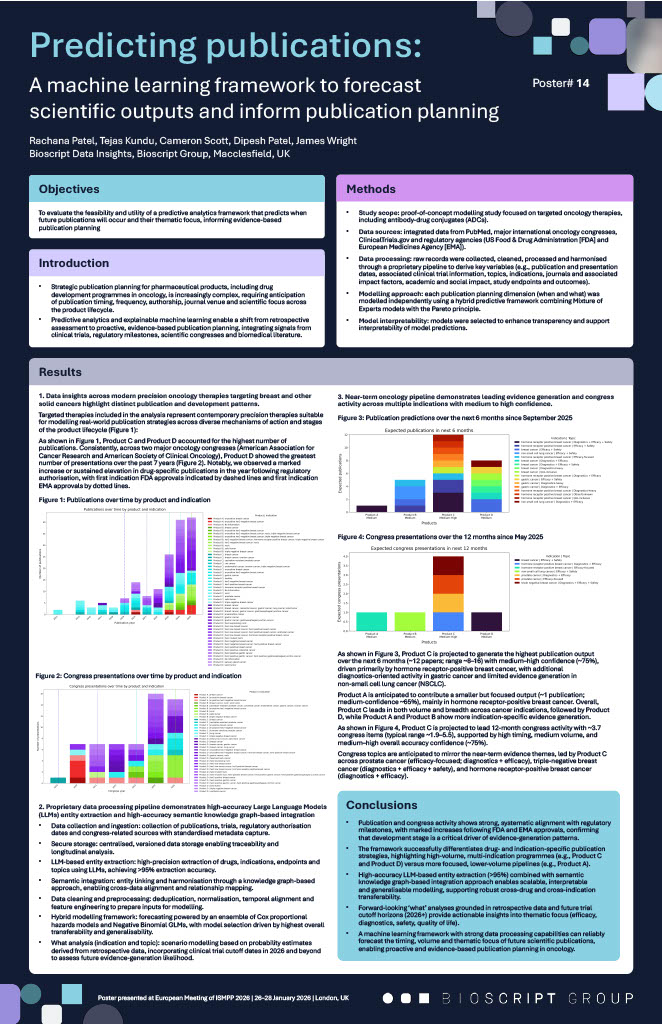









Publication planning in oncology is getting harder to do well. With a growing number of products in development and more congresses to cover, teams are still expected to accurately anticipate publication timing, frequency, journal target and thematic focus.
But the challenge isn’t a lack of data. The challenge is knowing how to interpret it and using the data to inform effective planning.
Congresses, clinical trials and biomedical literature all contain valuable signals, yet these datasets often exist in isolation. As a result, publication planning can remain reactive. Clinical trial results are announced, regulatory decisions are made, and publication strategies follow. This means that organisations may be catching up to the evidence rather than getting ahead of it. Without a forward-looking view, teams risk missing opportunities to optimise congress planning, journal targeting and resource allocation.
At Bioscript Data Insights (BDI), we’ve been exploring how predictive analytics and machine learning can provide a different starting point. By identifying patterns in retrospective evidence, our framework can help forecast the timing, volume and topic of future scientific publications to support proactive, evidence-based publication planning.
This blog is based on a poster presented at the European Meeting of ISMPP 2026. The original poster presentation, available to download below, explores the methodology, forecasting outputs and conclusions in more detail.
Building the forecasting framework
Our aim was to build a machine learning framework that could forecast when future publications will occur and what they’re likely to cover – providing publication planners with a forward-looking picture grounded in real–world evidence, not just assumptions.
This proof-of-concept study focused on targeted oncology therapies, including antibody-drug conjugates (ADCs). These therapies represent modern precision oncology treatment approaches and provide suitable examples for modelling real-world publication strategies across different mechanisms of action and stages of product development.
The study integrated data from PubMed, ClinicalTrials.gov, major international oncology congresses and regulatory agencies including the US Food and Drug Administration (FDA) and the European Medicines Agency (EMA). These datasets were processed through a proprietary pipeline to extract key variables, including publication and presentation dates, clinical trial information, topics, indications, journal impact factors, study endpoints and outcomes.
Understanding the patterns
Using this framework, we were able to highlight distinct patterns in product publication and data presentation.
The framework successfully differentiated drug- and indication-specific publication strategies, highlighting high-volume, multi-indication programmes versus more focused, lower-volume pipelines.
These historical patterns then formed the basis of the predictive models, enabling the framework to forecast future publication and congress activity.
Predicting future publication activity
Following pattern recognition, the framework was able to generate near-term predictions for both publications and congress activity. Publication output was forecast over a six-month horizon (figure 1), while congress activity was modelled across twelve months (figure 2). Predictions included confidence estimates, providing transparency around the expected accuracy.
For example, one product within the analysis was projected to generate up to 12 publications over six months, with medium-high confidence (~75%). The same product was predicted to lead future congress activity.
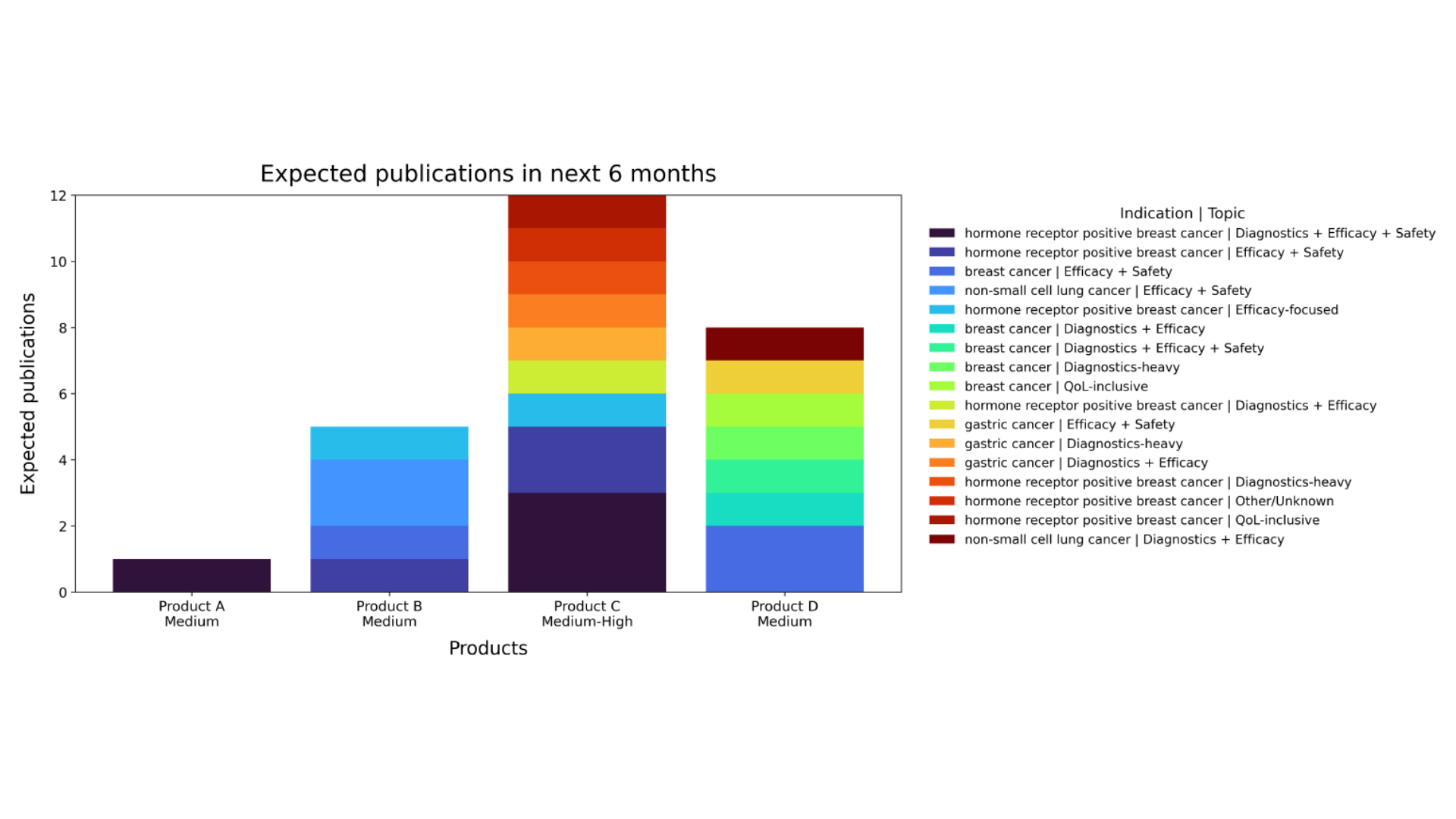
Figure 1: Publication predictions over the next 6 months since September 2025
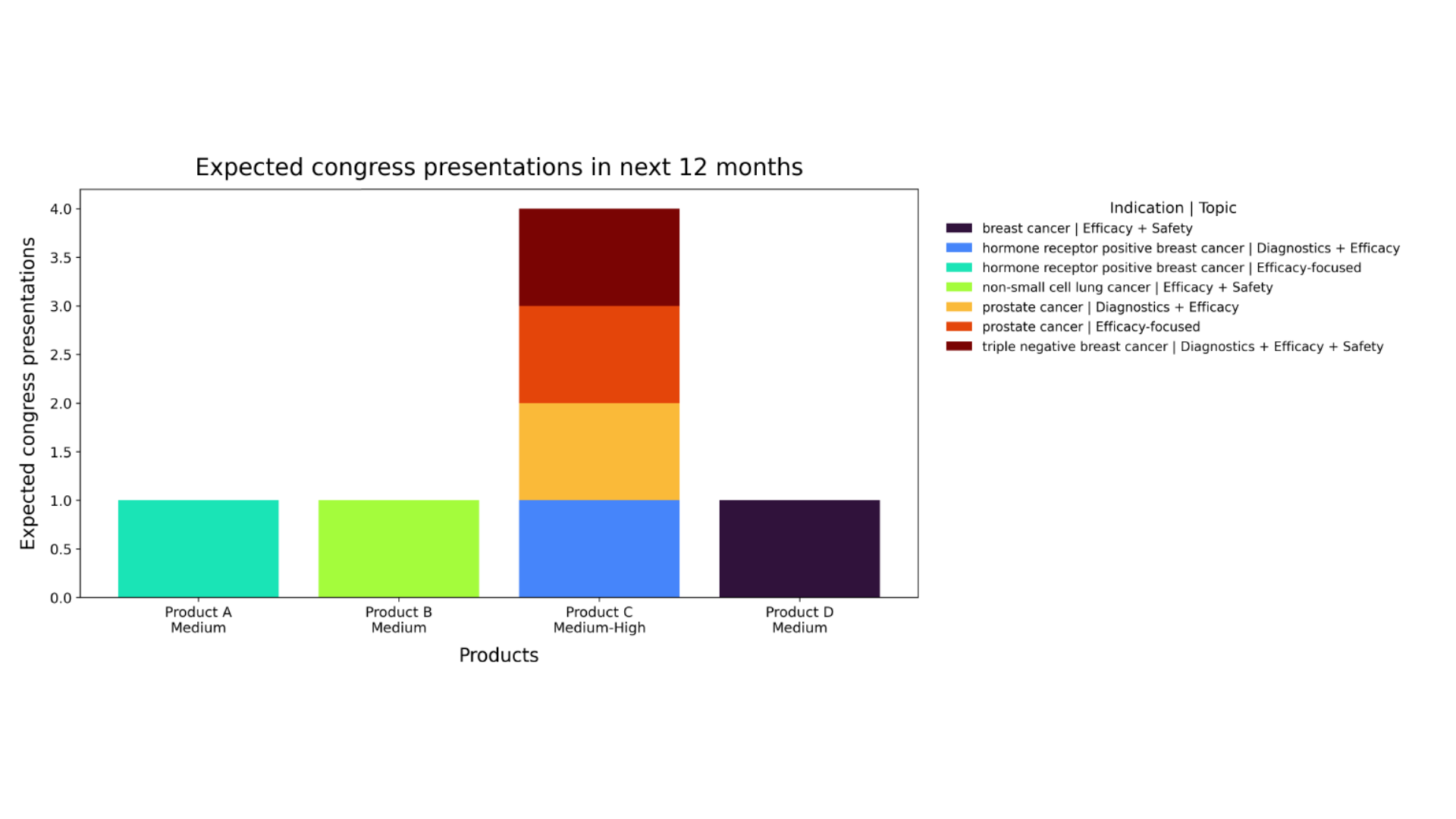
Figure 2: Congress presentations over the 12 months since May 2025
Scenario analyses incorporating future clinical trial cutoff dates extending into 2026 and beyond also enabled predictions about likely scientific themes, including:
- Efficacy
- Diagnostics
- Safety
- Quality of life
These forward-looking analyses provide publication teams with an opportunity to anticipate not only when evidence may emerge but also what scientific questions are likely to be addressed, supporting earlier publication planning, journal targeting and congress strategy.
Turning data into strategic insight with BDI
Our findings suggest that forecasting publication activity is not only feasible, but also actionable. By combining robust data processing, explainable machine learning and integrated evidence sources, it is possible to forecast future scientific publications with meaningful confidence.
This has important implications for publication planning. Journal targeting, congress planning, gap analyses and resource allocation can all be informed by predicted product trajectories.
Rather than relying solely on retrospective analyses or experience-based assumptions, teams can now begin to anticipate when new evidence is likely to emerge and what it is likely to cover.
As publication planning becomes increasingly integral to communication strategies, organisations that can effectively turn data into actionable insight will be better positioned to make decisions that are proactive, evidence-based and strategically impactful.
Download the ISMPP poster presentation
To access the original poster presented at the European Meeting of ISMPP 2026, download it below for additional detail on the methodology, forecasting outputs and conclusions.
If you’d like to discover how Bioscript Data Insights (BDI) can help you transform data into actionable insights, get in touch with the team.
Get in touch with the BDI team